Showing posts with label women. Show all posts

3 Aug 2010

I just spent a thoroughly wonderful day in the company of BJJ black belt Gazzy Parman. She's here to travel, tour and conduct a seminar at the Roger Gracie Academy in London this coming Sunday (8th August). But today was all about Gazzy the model. I took the day off work so I could accompany Gazzy to the academy where I train (Mill Hill BJJ) in north London where top BJJ photographer James Oluoch-Olunya was to do a series of jiu-jitsu and non-JJ photos. It was a right hoot since Gazzy was a barrel of laughs and we all had a smashing time...including my skull, which I'll get on to later...


Photographing Gazzy

I just spent a thoroughly wonderful day in the company of BJJ black belt Gazzy Parman. She's here to travel, tour and conduct a seminar ...

10 May 2010


*** UPDATE ***
10th June 2014
BJJ Heroes has found the first female black belt in BJJ - Yvon Duarte. Read about her here:- http://www.bjjheroes.com/bjj-fighters/yvone-duarte

For posterity, the original blog post is as below:

******

I began researching this post ages ago with one simple question: who was the first woman to achieve the rank of black belt in Brazilian Jiu-Jitsu?

No one I asked seemed to know the precise answer. Wouldn't you think the first female black belt would be a landmark moment, a stupendous achievement against great odds?
Something that would be recorded in the annuls of BJJ history?

Obviously not. My quest was to take me across the globe (figuratively speaking) to quiz some of the leading authorities and female icons in BJJ today. Along the way, I learned a lot of new things...


The First Lady of BJJ

*** UPDATE *** 10th June 2014 BJJ Heroes has found the first female black belt in BJJ - Yvon Duarte. Read about her here:-  http://www.b...

1 Apr 2010

Each month I post a short interview with interesting BJJ people I meet on the UK scene. For April 2010 ladies and gentlemen, I bring you the very excellent: Leoni Munslow.


Fighter Profile: Leoni Munslow

Each month I post a short interview with interesting BJJ people I meet on the UK scene. For April 2010 ladies and gentlemen, I bring you the...

12 Mar 2010

Woot! My interview and photo feature is published in the new April issue of Martial Arts Illustrated magazine. I'm really pleased with the way they have laid it out, looks pretty nice I think.


During the photo-shoot, Ana demonstrated a really cool lapel choke using your own gi. It involves a bit of leaping into the air and jiggery pokery with the gi skirt, but MAN! what a technique!!! So I've taken the liberty of presenting it here in its step-by-step form...


Indian lapel choke

Woot! My interview and photo feature is published in the new April issue of Martial Arts Illustrated magazine. I'm really pleased with t...

25 Feb 2010


I'm really fascinated with BJJ gi designs, as you can probably tell from my previous posts, so it's quite nice whenever I get the opportunity to talk to gi makers about how they go about their business.

Triin Seppel is a mum of two who happens to love BJJ. She loved it so much she started up her own BJJ gi company, called Fenom. And what a gi! Based on reviews from happy punters Meg, in her blog here, and Georgette, here, it looks like Triin is onto a winner. But Fenom is more than just a gi company, it's a personal mission, nay, a crusade by its founder to empower women who train jiu-jitsu and to get more women to join the BJJ sisterhood.

I thought it would be a good idea to ask Triin a few questions to find out more about her company and her plans to takeover the world, Fenom style:

[Photo credit: Danny Nguyen c/o Fenom on Facebook]

Fenomenal! - Interview with Fenom Kimono founder Triin Seppel

I'm really fascinated with BJJ gi designs, as you can probably tell from my previous posts, so it's quite nice whenever I get the o...

10 Feb 2010

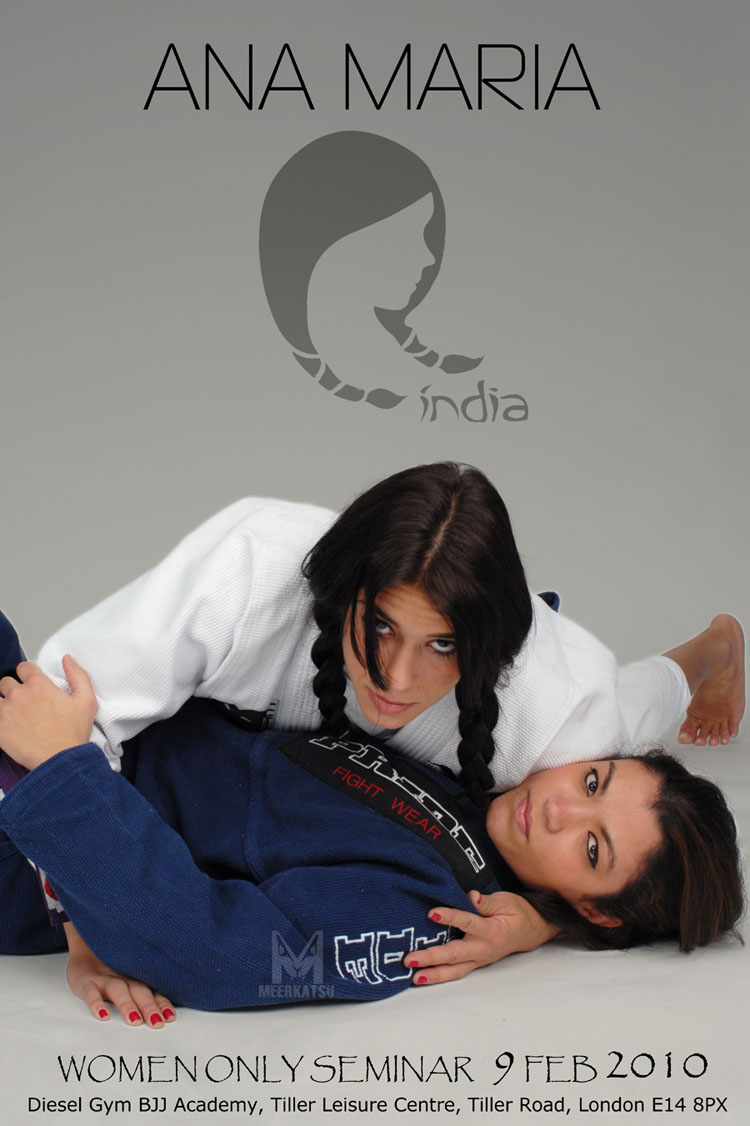
My photo shoot with Ana Maria India went really well I think. She's a willing model and I had lots of help from my wife and my BJJ friends Pippa and Amora - who was also our interpreter. I'm gonna save the pictures for magazine to hopefully use first but I couldn't resist releasing one of my snaps as part of a poster to advertise Ana's women only seminar. However, I wasn't to expect the minor controversy that it caused. See for yourself...

Poster Girls

My photo shoot with Ana Maria India went really well I think. She's a willing model and I had lots of help from my wife and my BJJ frien...

7 Feb 2010

Seminar with Ana Maria 'India' Soures Gomes
6th February 2010
KO-Legacy Gym, Bethnal Green, London


KERRRRRPOWWWWWWW! Female black belt Ana Maria 'India' just hit the target with an awesome seminar! For me, this was by far the best seminar I've ever attended. Not to disrespect the dozen or so previous black belt seminars I have attended in my 7 years of training BJJ, but today, the techniques I learned just totally rocked.

Indian Tonic - seminar with Ana Maria 'India'

Seminar with Ana Maria 'India' Soures Gomes 6th February 2010 KO-Legacy Gym, Bethnal Green, London KERRRRRPOWWWWWWW! Female black ...

4 Nov 2009


I came across this photo for the forthcoming edition of Ultimate MMA magazine and I thought it was really cool.

So I posted it on the forums and was unpleasantly surprised by some of the responses – some of which have since been removed. So this blog entry is about the BJJ and MMA fighter Cristiane Santos, more popularly known as (Mrs) Cyborg.


According to her website, she earned the nick-name ‘Cyborg’ when she started dating Evangelista Santos, himself a well-known MMA fighter with the nick-name Cyborg (the two are now married).

Her Wikipedia entry states she has an MMA record of 8 wins and 1 loss.
Her most high profile fight was against Gina Carano in August [click here for fight report]. The fight was the first time that a major MMA promotion (Strikeforce) has featured a women’s fight as their main event.
She is also a BJJ purple belt and recently fought Penny Thomas in the semi-final of the ADCC in Barcelona. In my interview with Penny (out in shops soon folks!), she talks of her in glowing terms. Mrs Cyborg is clearly a very competent and highly regarded competitor and fighter.

So why the controversy?
One quick google search of her name brings up a large amount of commentary from various people – stuff about her looks, her sexuality, her personality – basically lots of vile and misogynistic comment. Quite awful really.

Now this type of banter is common to sports in general. Look at the kind of remarks that athletes such as Fatima Whitbred and Martina Navratilova have had to endure over the years, and more recently, Caster Semenya.

Anyway, I don’t want to dwell on the negative, let’s look at the positives to this amazing character, woman and person:

Here’s a funny video where she puts to sleep a reporter:


Here is a highlight reel.

Her MySpace page:


Mrs Cyborg

I came across this photo for the forthcoming edition of Ultimate MMA magazine and I thought it was really cool. So I posted it on the fo...

12 May 2009

Well after the high of the Essex Open, it was back to the mats for me. Or rather, it wasn't. Due to family circumstances I missed a complete week of training, which was annoying as it was the first time I started paying monthly fees and nothing winds me up than not getting my full money's worth ;)
Despite this, I did sneek in for a quick roll during the Saturday morning open mat. And I even persuaded my wife to attend the Women Only BJJ seminar with European champion Carmen Janke. It was the first women-only seminar of its kind in the UK and was a great success with over 20 ladies on the mat - some travelling long distances to attend. I defy ANY BJJ club in the UK to drum up 20 women at one time. Well done to Pippa Granger for organising the event at such short notice, let's hope there are many more to come. You can read more about the seminar here at Meg Smitley's blog.

Mrs Meerkatsu on lower far right

As for my own training, some things are clicking nicely in my game, a lot needs working on. Same old same old I guess, but at least our instructor is there to assess whether we've actually made any progress. One of the unforgiving aspects to BJJ is the sparse interludes between grades. With only 5 belt ranks and maybe ten years to reach black belt, that's a long time to train wearing the same belt colour. But BJJers get used to it, and even revel in a perverse way at how lowly our current rank is. So it is with a humble kind of honour that I am happy to report another stripe was awarded to my good self last night by Nick Brooks. That makes me a blue belt 4 striper, the maximum rank for that belt.

4-stripe!

Well after the high of the Essex Open, it was back to the mats for me. Or rather, it wasn't. Due to family circumstances I missed a comp...

17 Mar 2009


Brazilian jiu-jitsu is one of the fastest growing sports in the UK, but the number of women who take part and compete are still in the minority. Seymour Yang investigates what motivates this small but growing band of jiu-jitsu sisters.

There is no doubt that Brazilian jiu-jitsu (BJJ) is a male dominated sport. In the 2009 European Championships just 84 women took to the mat, compared to 1,164 men. It is a stark statistic. But in academies up and down the country there are women, or sometimes just the one woman, who take their training every bit as seriously as the guys. What experiences did these women have of competing? And how can BJJ attract more females?

One of the common problems faced by female BJJers is the lack of other women to compete against. In the early days - which to be honest was only a few years ago, the few women who did compete often had to enter the mens brackets just to get a fight. Even today, many women turn up and see the same faces at each tournament. Caoimhe McGill is one of only a handful of British competitors, male or female, to have won at the Mundials. Currently a purple belt at Revolution Team in Belfast, she remembers difficult times on the competition circuit:
"When I first competed, at the Gracie Invitational in 2005, I had just become a blue belt the week before. With all the weight categories together there were 2 of us [women]. "
“I have fought up 2 weight categories in male competitions just to get a fight as there is often not many light weight boys either.”

But the scene is changing. Caoimhe notes that in recent comps there were very large blue and white belt categories with full numbers at all weights. A sign, maybe, that more women are coming into the sport.

One of the new wave of female BJJ fighters is Camilla Hansen, a blue belt under Eddie Kone (EKBJJ). Camilla first attended a BJJ class out of curiosity : “In my first class I got schooled by a bunch of people, took it as a challenge and kept coming back.” She has since added gold in the open weight female blue belt division of the 2009 Winter leg of the Bristol Open to her medals from SENI (gold) and ADCC trials (silver) last year.

Despite being one of the fastest growing sports in the UK, the lack of women who train and compete still persists. One reason could be BJJ’s close association with MMA and all the macho hoopla that surrounds that sport. But the notion that women are put off from the combat side of things is probably not quite as true as some may think. The success of British women in Olympic judo and taekwondo proves that women do love to fight.
Camilla Hansen has another theory, she thinks: “Maybe 1 out of 50 guys who try BJJ out actually stick with it for 2 years or more. I believe the same statistics apply to girls. However as a lot fewer girls actually try out BJJ (or martial arts in general) the number of girls who train is very small.”

The problem therefore is getting the women into the classes in the first place. But BJJ academies are trying to redress the balance. Many now offer a women only classes and self defence workshops. One well known program from the USA is Rorion Gracie’s ‘Women Empowered’ program, formerly known as RAPESAFE.

Caoimhe McGill said this about self defence programs: “I think any alive martial art would be good as a self defence. But they would have to train it as we do and spar to ensure what you have learnt works. I've seen some self defence classes taught very badly and leave the women more vulnerable as they think they can defend themselves but are none the wiser.”

So how do women find training with the guys day-in, day-out?
Dominique Vitry is a blue belt under Roger Gracie. She’s a regular on the competition circuit having won medals at SENI, Bristol Open and the Kent Open. I asked her how she approaches sparring sessions against guys: “I tend to play it by ear as to how I’m going to react…the main issue is how technical the person is; if they’re good, it makes no difference if they’re a man or woman (though I’ll mind where I put my knees).”

Most of the women agreed that there were actually very few differences between the genders in terms of how they fight. On the whole, women opponents were considered more flexible than the men, which results in a slightly altered game plan.

But they did come across some guys who had a problem with the female being the better fighter. Caoimhe recalls an incident at the Irish Open a few years back: “They had a new rule that a competitor couldn't talk to their corner. I was beating this guy by loads of points and he was getting very frustrated by it. I had my head low and was nearly passing his guard when he started laughing, talking to his corner in a foreign language in what came across as dirty talk. He was disqualified which is what he wanted as he didn't want to have to tell people he was beaten by a girl.”

Of course most people hate to get tapped out, regardless of gender, it’s the nature of the sport. Camilla offers her thoughts: “I have had everything happen within the range of some guys using all their strength to “get back” at me and prove something – to others who just think its great - to one or two who have simply not resisted and let me tap them again and again. Luckily most guys just accept it and continue.”
“It shouldn’t be a big deal. Everybody gets tapped.”

No article about women and BJJ would be complete without some mention of Kyra Gracie. Granddaughter of Robson Gracie, Kyra is a multiple World Champion and a popular poster girl pin-up for the boys.
Caoimhe McGill actually fought Kyra at the 2007 ADCC. She thinks it is good to have a famous name that everyone knows: “I am glad that I have had the opportunity to compete against her and would love to again. But I also think that it would be better if the famous female fighter was friendlier and more encouraging to other females in the sport” says Caoimhe.

On the subject of friendliness, the women fighters I spoke to found that tournaments were a great opportunity to make friends and all enjoyed a camaraderie, probably as a result of the female competitors being in a minority. Dominique says she loves the family atmosphere at tournaments: “we all have a laugh and are like one big team.”

It is often commented that women’s football is as skilful and often more free-flowing compared to the men’s game. In many respects, women’s BJJ could be seen in the same way. In a world where high value is placed on being an absolute champion or MMA superstar, sometimes just as much can be enjoyed by watching and learning from the lighter, faster and the more technical. In this respect, female BJJ fighters are a force to be reckoned with. Welcome then, to the Jiu-Jitsu Sisterhood.

Article (c) 2009 Seymour Yang
Photo credits (top to bottom): Keith Mills/ADCC Japan, Caoimhe McGill website, James Oluoch-Olunya/combat-bjj.com, jordanjiujitsu.com,

Full interviews:
Caoimhe McGill
Camilla Hansen
Dominique Vitry


The Jiu Jitsu Sisterhood

Brazilian jiu-jitsu is one of the fastest growing sports in the UK, but the number of women who take part and compete are still in the mi...

8 Jan 2008

The Meerkat is back, well sort of. Two and a bit months busy rearing mini-meerkats and doing sod all exercise means a very unfit and out of sorts kat. So off I went for a run last night, and immediately started wheezing uncontrollably. I was determined to continue so that's when the heart palpatations kicked in. Clearly I am in a poorer state than I imagined. So more running is needed, thankfully it gets dark early so no one can see my pathetic broken frame lumbering through the streets of B'wood.

All my time off has not been entirely a martial art wasteland. Thanks to youtube, I can enjoy more obscure footage, like this awesome vintage jujitsu video. I would say it is 1940's (rather than 1920's-30's as described). Mr Chomley Warner and his Pathe news pals would be proud.


Happy New Year to all my readers.

The 'weaker' sex

The Meerkat is back, well sort of. Two and a bit months busy rearing mini-meerkats and doing sod all exercise means a very unfit and out of ...

1 Jan 2000

MEERKATSU INTERVIEWS

Dominique Vitry

10th March 2009

1. How/when did you get into BJJ? Where and who do you train under now.
2. What is your belt rank and competition record?
3. Do you find it hard to train in a club where majority are blokes?
4a. What is your view on the competition scene where currently so few other women compete? Or is the scene changing?
4b. What things have you had to do just to get a match? eg move up or down a weight/rank/travel far etc
5. What do you think the sport needs to do to attract more women? What things would you like to see change/ happen within the BJJ scene.
6. Some BJJ is marketed to women as a self defence program - I'm thinking of the RAPESAFE
(http://www.gracieacademy.com/rapesafevideo.html)
program in the US. What do you think of this strategy and do you think BJJ is a good self defence (specifically for women) generally?
7. Who do you admire in the BJJ world?
8. What is it about BJJ that you specifically enjoy?
9. Do you adapt your game depending on whether you spar against a male or a female?
10. How do you respond to male-banter that goes on sometimes, which may or may not include sexist remarks?
11. How do you combine serious training together with all your other
roles - particularly if you have kids - but if not then finding time for job, partner, other stuff etc.


1. I got into BJJ 2 ½ years ago, starting at Roger Gracie Academy in Ladbroke Grove. I trained regularly, taught by Roger, Jude, Felipe, Nick Brooks and Nick G. Although I still train at Roger’s, most of my training is now at RGA Mill Hill with Nick Brooks.

2. I am a blue belt /1 stripe, and have competed at Seni in 2007 and 2008 (Bronze); Bristol in 2007 (Silver) and 2009; and Kent (Silver) in 2008.

3. I have no problem with who I train with – I can still give them a run for their money! Well, sometimes…

4a. It is annoying when women are grouped together as one big weight category, or combined with a
higher or lower category due to numbers. It’s not fair on lighter fighters I have had to fight, and I know
how tiring it can be when fighting someone much heavier than me. It also means that sometimes, we
are put to fight at the end of the day – not good when you’re dying to have something to eat! The
scene appears to be changing with lots more white belts competing, but sometimes they don’t continue
training to blue belt and above.

4b. I have had to cut weight for competition, but not too far below my natural weight. I have travelled to
Bristol from London, which is the furthest I’ve travelled for a comp. However, this was not just to get a
Match.

5. Perhaps women-only classes would attract more women, but I prefer to have a mixed class as many of
the women I’ve fought are quite flexible, so you sometimes have to use a different game for them
compared to men.

6. I think BJJ is very useful for defending yourself; I definitely feel I can handle myself more now, than before I started. If I had to use it on the street on someone who didn’t know BJJ, because of the nature of what we do, I’d probably hurt them before they realise what is happening (I hope!). BJJ is good because the size of the person isn’t so important when defending yourself – although I am small, I am quite quick and defensive. I know some really light girls and guys who are brilliant technically, and can submit much heavier people.

7. Roger Gracie, he’s number one! He’s shown me some really useful BJJ techniques and relies on the basics when submitting opponents. Then there’s Nick G, who did my induction and has coached and encouraged me all the way – especially at competitions. Jude has also taught me lots...it just clicked one day and my game improved. I love the way Nick Brooks teaches – he has personalised my training and hopefully in time I’ll be submitting him! He shows me things that work for me, especially as he is light too, and has told me when to let things go…Daniel Strauss is just on another level – he is so good for someone so young, as is Michael Russell. Felipe is also great; he taught my kids BJJ. Did you mean famous names?

8. The family atmosphere, especially at competitions – we all have a laugh and are like one big team. You coach and cheer for other RGA members despite never having seen them before, so it’s a good way to get to know people from your academy. Generally, you learn something new with each lesson, and can’t wait to try it out when sparring.

9. When fighting, I tend to play it by ear as to how I’m going to react. I usually have to be more defensive when fighting men, unless I’m using spider guard…the main issue is how technical the person is; if they’re good, it makes no difference if they’re a man or woman (though I’ll mind where I put my knees). If I’m fighting anyone heavier than me, I’ll do my best not to end up with them in side control.

10. I don’t mind banter – it makes the classes fun and we all have a laugh.

11. Sometimes it’s hard fitting time in for training, I have had to have a month or so off in the past due to work commitments. If I’m tired I may not feel like training, but I’m always glad afterwards when I have gone in. I can’t imagine not doing BJJ anymore…

Interview with Dominique Vitry

MEERKATSU INTERVIEWS Dominique Vitry 10th March 2009 1. How/when did you get into BJJ? Where and who do you train under now. 2. What is your...
MEERKATSU INTERVIEWS

Camilla Hansen

13th March 2009


MEERKATSU: What first attracted you to BJJ?

CAMILLA HANSEN: The challenge. I have been interested in martial arts since I was a kid, and when I started at university I saw they had a BJJ class running. I went along having no real idea of what grappling/submission wrestling etc was. In my first class I got schooled by a bunch of people, took it as a challenge and kept coming back.

MK:Why do you enjoy competing?

CH:It is interesting to spar with somebody who match you skill, strength and weight wise. Also it is a good chance to go against somebody who has a different game to what you are used to, and gives you a chance to realise where the shortcomings in your own game are. Plus I like the adrenaline rush.

MK:Why do you think BJJ attracts so few women?

CH:Maybe 1 out of 50 guys who try BJJ out actually stick with it for 2 years or more. I believe the same statistics apply to girls. However as a lot fewer girls actually try out BJJ (or martial arts in general) the number of girls who train is very small. It is my impression that where martial arts in some ways are natural for men to take up (or at least try out), it isn’t as natural for a girl to just go and see what it is about.

MK: What differences do you notice between sparring with a guy and sparring with a girl?

CH:I find it hard to point out specific differences between sparring with men and women. I generally try to adapt my game to each of my training partners: some people you have to go light on, some you can go hard on, and some you have to give everything to avoid becoming mat fodder. It is not really gender specific.If I have to mention one thing, it is a question of size and strength. The majority of the girls I spar with are smaller and less strong than I am (or the people I am used to sparring with), which makes me focus more on technique than strength. But if I happen to train with a guy who is smaller and less strong, my focus is exactly the same, it just doesn’t occur as often.

MK: What reactions do you get when you tap out a guy?It depends on the person.

CH: I have had everything happen within the range of some guys using all their strength to “get back” at me and prove something – to others who just think its great - to one or two who have simply not resisted and let me tap them again and again. Luckily most guys just accept it and continue. It shouldn’t be a big deal. Everybody gets tapped.

MK: Do you think guys underestimate how technical and strong female players can be?

CH: Again it differs from person to person. I think it very much depends on how their previous experiences with women in BJJ have been. If they have had a wallflower or two in the club, who everybody had to treat with kid gloves, it will in many ways colour their expectations of other women’s proficiency in BJJ.If on the other hand they have trained with women who could hang with the guys, and were every bit as technical and strong as the average guy their size, their expectations will be coloured by that.

MK: Do you think categories at BJJ and subgrapp events should be mixed gender?

CH: I would love it to be! But I can see the arguments for and against.

MK: How do you react to male dominated or sexist banter in the gym?

CH: Sticks and stones. I’ve been doing martial arts since I was 15. I have gotten used to the environment I guess. Most of the time I can laugh at it as well. It is however my impression that guys generally play it down a bit when there are girls around.

MK: In tournaments, do you find there is a general camaraderie between female competitors, or is it all tension and focus?

CH: General camaraderie. The few times I have competed I have been pleasantly surprised with the friendly attitude between competitors.

MK: What are your future goals in the next few years?

CH: I have never really put up goals. I just want to get better at BJJ in general. When I started out I didn’t even consider competing, but I have found I enjoy it. It could be fun to try going for some of the bigger competitions.


ENDS (c)2009 Seymour Yang

Interview with Camilla Hansen

MEERKATSU INTERVIEWS Camilla Hansen 13th March 2009 MEERKATSU: What first attracted you to BJJ? CAMILLA HANSEN: The challenge. I have been i...
THE MEERKATSU INTERVIEWS

Caoimhe McGill

27th February 2009

Meerkatsu: How/when did you get into BJJ? Where and who do you train under now?

Caoimhe McGill: I started with traditional ju jitsu as a needed to get a black belt to get on the stunt register. But after seeing BJJ in sep 2004 I gave up on that and have loved BJJ since. I now train with Waqar Ahmed in Revolution Belfast.

MK: What is your belt rank and competition record (or summary of proudest achievements)?

CM:I am purple belt which I received from Carlos Gracie Junior after winning the mundials at blue belt level in 2006. I am also glad to have fought against Kyra Gracie in ADCC world final in Trenton New Jersey after winning the ADCC European qualifiers at under 63kg in 2007. I have come 1st place in the Gracie Invitational in my weight in 2005, 2006 and 2008. I was unable to compete in 2007.
I have also done well in many competitions were I have had to fight in the mens categories such as Irish Open and Supreme National Grappling Championships.

MK: Why do you compete?

CM: I have a competitive nature and really enjoy competing in BJJ and submission wrestling competitions. I prefer the gi but as there are not so many competitions I started no gi just to be able to compete more.

MK: What is your view on the competition scene where currently so few other women compete? Or is the scene changing?

CM: When 1st competed in the Gracie Invitational in 2005 I had just become a blue belt the week before. With all the weight categories together there were 2 of us. Unfortunately since I am at the upper end of female ju jitsu in the UK I still don't get as many competitors, there were 4 of us in the purple belt open. But there were very large blue and white belt categories with full numbers at all weights. This is great, hopefully there will soon be full categories the whole way up to black belt.

MK: What things have you had to do just to get a match? eg move up or down a weight/rank/travel far etc

CM: Until recently I have never changed weight for a competition as I just love doing it and have seen those changing weight suffering and not enjoying their fight or fighting to their full potential. I also don't agree with changing your body weight by hugh amounts. I only changed weight recently for ADCC European final as we did qualifiers in UK at under 60kg as we were fighting for it to be the split if there was only going to be 2 weight categories as it is closer to the middle of female weights. But the Europeans didn't get changed and knowing how big some of the girls had been in the world finals the previous year I thought it more sensible to drop 3kg. Unjfortunately it didn't work out as they increased the weight to 60kg (the weight we had originally wanted) 6 days before the competition so I bulked up again, only to discover that they decided it was too close to the competition to change it. When they changed it back I was now over weight and very annoyed with the event organisers as this was very unprofessional.
I don't think it is safe to have so few weight categories, especially if they cut off point is so low. It encourages eating disorders. When you are small just losing a few kilos could be a very high perecentage of your body weight.

MK: You voiced your frustration at the recent Kent Open where you were not given the chance to fight in the men's division, do you have any further views on this, and do you think all tournaments should have mixed gender divisions?

CM: I think there is a time and place for mixed gender competitions. When the competition is a qualifier for a larger competition were there will be more competitors to fight against in future rounds it is not necessary.
If it is a locally run competition for fun and competition experience I think it is necessary. Otherwise when I fight in Europe I will not have have enough local competition experience.
I have fought up 2 weight categories in male competitions just to get a fight as there is often not many light weight boys either. But there are physical differences between girls which may not make a straight swap the way to go. Maybe if females fight in males they could drop a belt or weight category if possible. This would make it fairer for the boy and girl. The girl will get a fight, the boy doesn't have to feel bad if they lose as they are a higher belt or weight so there is an excuse for them to use. I don't know if this is the way to go, but there must be a way.


MK: What do you think the sport needs to do to attract more women? What things would you like to see change/ happen within the BJJ scene.

CM: I have been to some competitions with pretty poor changing facilities and toilets. So better venue choices might be good. I have recently discovered that a lot of clubs have females even at purple belt level who have never competed. Maybe they need to be asked what would encourage them to compete. There are a lot of competitions who only give prizes to the male categories which is discriminatory. They say iit is because there are not so many in that category, but maybe if they offered prizes it might encourage participation. Maybe if they organised some female superfights for categories that won't have many competitors.

MK: Some BJJ is marketed to women as a self defence program - I'm thinking of the RAPESAFE (now known as Women Empowered)program in the US. What do you think of this strategy and do you think BJJ is a good self defence (specifically for women) generally?

CM: I think any alive martial art would be good as a self defence. BJJ is beneficial as being held on the ground is a situation that a female would really need to be able to get out of. But they would have to train it as we do and spar to ensure what you have learnt works. I've seen some self defence classes taught very badly and leave the women more vulnerable as they think they can defend themselves but are none the wiser.

MK: Do you think Kyra Gracie is a good role model for women in the sport?

CM: I think it is good to have a famous female name that everyone knows. I am also glad that I have had the opportunity to compete against her and would love to again. But I also think that it would be better it the famous female fighter was friendlier and more encouraging to other females in the sport.

MK: As one of the handful of senior level female BJJ players in the UK, do you feel under any pressure/obligation/desire to be a role model yourself?

CM: I hope that I would be an encouragement to other females wanting to get into the sport. I do try to encougage female participants, but my memory is so bad I keep forgetting who people are, so I hop I don't come accross as unfriendly. I hope that I keep my fights interesting so the sport seems more tempting to others. I am really embarressed if I end up having a boring stalling match whether I win or not. They are the only fights I have regretted afterwards and I always wish I had been more expermental even if it meant losing.
I dont feel being a role model has to be a pressure, as long as I have given a good fight that I am happy with. As long as I am having fun and the other competitors are having fun that is the main thing.

MK: How do you respond to male-banter that goes on sometimes, which may or may not include sexist remarks?

CM: I was fighting once in the Irish open and they had a new rule that a competitor couldn't talk to corner thay had to comunicate through the the ref. I was beating this guy by loads of points and he was getting very frustrated by it. When i had my head low and was nearly passing his guard he started laughing talking with his corner in a foreign language in what came accross as dirty talk. He was disqualified which is what he wanted as he didn't want to have to tell people he was beaten by a girl. I'd have prefered the fight to go on.

MK: Do you think guys underestimate how strong/skilfull/technical women players are?

CM: If they have not fought many girls they definately do. When a guy starts training in the club they don't fight properly against you. They try to take it easy and keep the weight off. Arm barring them a few times soon rectifies that.

MK: Generally speaking, how would you describe the differences (if there is any) between the way women train and fight, compared to men?

CM: We all do the same training, there are always moves that suit individual participants, but not different for girls and boys. But when I did my 1st competition I had never even sparred against a girl, there had never been any at training. It was very weird on the mat as female competitors do move very differently. They are generally more flexible and use this to their advantage.

MK: What reactions do you get when you tap guys out?

CM: Guys who don't know me are very surprised. I love to tap out roid heads who are using all their strength, their faces are a picture. Guys who know me know that the fight could go either way, just as it would if they were fighting a boy.
Most guys are not bothered about sparring or competiting against a girl, but there are always a few.


ENDS (C) 2009 Seymour Yang

Interview with Caoimhe McGill

THE MEERKATSU INTERVIEWS Caoimhe McGill 27th February 2009 Meerkatsu: How/when did you get into BJJ? Where and who do you train under now? C...


© 2015 - Distributed By Free Blogger Templates | Lyrics | Songs.pk | Download Ringtones | HD Wallpapers For Mobile